

Change Management.
-
Maintain Your Team’s Momentum
Five simple ways to keep your project team motivatedYour project kick-off was exciting. Your team was laser-focused and energized. But, now that the project is a few months in, the team’s enthusiasm is starting to wane. What can you do to restore your momentum and keep the team motivated?
It’s a basic rule of human nature: people are more likely to repeat a behavior when it produces a reward. Here are some tips to keep the team motivated and moving.
Individual Recognition
Hard-working people want to hear what they have done well. And remember: recognition is best when it’s specific and delivered close to performance.
- Verbal Recognition. Don’t underestimate something as easy as verbal praise! A simple pat on the back or recognition during a team meeting can make a big difference.
- Public Acknowledgement. Send a “kudos!” email about an individual to the team, or post a spotlight piece on the project website.
- Gamification. Many people enjoy friendly competition with others. Gaming mechanics that recognize performance, like point scoring and leaderboards, can boost team engagement and productivity.
Team Appreciation
- Team Event. Host a group outing to give your team a boost. This helps get them past those inevitable project dips and up the next hill.
- Publication. Celebrate a milestone on your project by submitting an article and team photo to a company publication. This is a great way to raise project awareness and showcase the hard work of the team.
Often initiatives that are most important to the organization are a long haul for team members. Rewarding them is a great investment in your project’s success and way to keep the team motivated.
-
How To Change A Toxic Culture
Changing a toxic workplace requires drastic measures. But it can be done.Culture is composed of the unspoken rules that drive employee decisions. MIT Professor Edgar Schein defines it as repeated behavior. Lately, we’re seeing an increased number of companies whose unspoken rules and repeated behaviors create toxic work environments.
But how do you change a toxic company culture? Culture is deeply entrenched, and changing it is like shifting the course of a river. If we want to truly change the river of culture, we need dynamite and dams – drastic measures reserved for an organization in existential crisis.
Dynamite
These are strategies intended to disrupt – to so dramatically change the geography that the previous terrain is obliterated and unrecognizable.
1. Focus attention. Humans change only when the current system no longer works for us. We must convey that the current system is unacceptable and over, then keep this message in the spotlight. For example:
- Terminate people who embody the toxic behavior — no excuses. Even if they are top performers.
- Change symbols that represent the old culture. Examine work spaces, pay scales, meeting structures, social rituals, and brand names. Such artifacts can trigger old habits. Rid the organization of them and replace them with fresh symbols that signal a new day.
2. Involve a critical mass of the organization. You need enough people to create momentum. Put them in a room at the same time. You want them to hear the same message and, ideally, work together to design new ways of working. You can even do this with hundreds of people at once – it’s incredibly powerful. When they leave, they will have a shared vision of what has to happen.
3. Move swiftly. Research shows that you must show progress within 90 days. Otherwise, people revert to their old habits. We encourage our clients to post their 90-day plan on their walls, and to update it with new information – successes and setbacks. This creates a sense of progress and unifies the organization around a shared experience.
Dams
These strategies ensure that the river moves exactly as intended. This is the infrastructure that embeds behavior into the normal flow of day-to-day operations.
4. Clearly define which behaviors must change and what is expected. Glittering generalities won’t cut it. For example, healthy people usually agree that we need to “be inclusive” and “operate with integrity.” The question is, what does that look like? What, specifically, do I need to do differently on Monday than I did on Friday? Simple, tactical behaviors, defined in small steps, move an organization forward.
5. Get your execs on message. Leaders must be able to describe what you are doing consistently and passionately, using their own stories, without relying on PowerPoint or email. When all of your execs are aligned and consistent, your employees know unequivocally that the direction is true. The easiest way to do this is to work with your executives to develop a message frame.
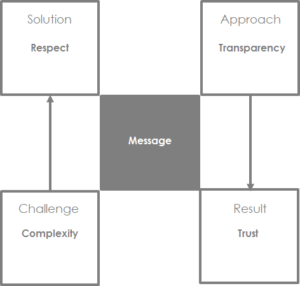
The message should answer four questions: What problem are you trying to solve? What is the solution to it? What approach are you using to implement that solution? And finally, what do you expect the result to be? Choose one word that represents the answer to each of the four questions. Why? Because it’s easy to remember four words.
6. Create the infrastructure to sustain the new behavior. You need people to monitor your progress and follow up when things go off course. Build training on new behaviors for new employees. Align performance management with your new values. Infrastructure is usually the easiest part of the change; the key is to establish owners and deadlines.
It takes courage and commitment to disrupt a toxic culture. It’s best done by moving swiftly with a clearly defined course and employee involvement. As employees succeed in practicing these new rules and behaviors, your culture will become a self-reinforcing system.
-
Good Reads on Behavior Change
Want to get geeky with us? Here are our recommended sources for behavior change wisdom.At last count, 44 billion GB of online content is created. Daily. That’s an intimidating number of cat videos, blog entries, and social media posts. In the era of fake news and less-than-reliable sources, a referral from a friend is often the best way to cut through the noise. So here are some of our team’s go-to behavior change sources.
Good to Great: Why Some Companies Make the Leap… and Others Don’t
Emerson consultant Afreen McKnight cannot put down Good to Great, a book by Jim Collins. The premise of the book is simple: how companies transition from being good to great. Collins and his team of researchers analyzed 1,400 companies on the Fortune 500 and narrowed the list to 11 companies that maintained excellence over time. Collins identified seven characteristics that contributed to their success. We won’t spoil the rest – read the book!
Austin Kleon’s Blog and Newsletter
If you’re like our COO Cathy Quon, you’re a fan of Austin Kleon. Maybe you’ve read Steal Like an Artist. If you don’t know Austin, Cathy suggests join the 50,000 who subscribe to his newsletter. Austin provokes his readers to think in outside of the digital world. He also talks about combinational creativity in Steal Like an Artist. This is one of our favorite quotes from the book, “The great thing about dead or remote masters is that they can’t refuse you as an apprentice. You can learn whatever you want from them. They left their lesson plans in their work.”
You’re probably wondering what a PBS show about cooking has to do with behavior change. Our COO Cathy tells us it delves into big ideas from some of the best chefs in the world. The chefs talk about food, what can be done with it, and how to grow and harvest in entirely new ways. Great chefs are inventors and change agents – just like us!
Barking Up the Wrong Tree Blog
This isn’t the first time I’ve mentioned Eric Barker. (See our entry on behavior change experts to follow on LinkedIn) Eric’s blog describes scientific findings that will help you “be awesome at life.” The simple lessons are applicable to your experience both in and out of the office. One post that resonated with me was about ways to increase attention span. Barker said, “You can improve your ability to focus by changing your brain or changing your behavior. And it’s best if you do both…the best way to change your behavior is to make sure that anything which might distract you is far away.”
Big thinking on behavior change inspires us in every area of life. Get out there and grab those nuggets of wisdom!
-
How Facebook Should Respond to the Media Storm
What should leaders do in the face of bad publicity? Here’s what our VP recommends for Facebook.Who would have thought a tech CEO testifying to Congress would make such good TV? Mark Zuckerberg talking about Facebook’s failure and its next steps has America watching. It’s not like we are all going to quit Facebook, but we do need to hear from its leaders.
That’s because what Facebook did and what they do next affects so many of us. Cambridge Analytica had access to our data and used it to influence elections. Yet, no breach had occurred, no one stole data, and no one used our data in violation of Facebook data security agreements. In fact, Cambridge Analytica followed procedures developed by Facebook and gained access to the data legally.
Facebook owns over ten companies including Facebook, Instagram, Messenger and WhatsApp and has unfettered access to the personal details, data and thoughts of over a billion people worldwide — by design and by choice. Following days of uncomfortable silence, the CEO and COO of Facebook are engaging in a concerted media campaign to protect the company’s image as a safe space to connect.
So what can — or should — a beleaguered leader do when confronted by an onslaught of bad publicity? Well, for one: agree on message. However unpleasant the underlying truth is, you have to be aligned on what you say about it. So far, Mr. Zuckerberg and Ms. Sandberg have not been aligned. They need a message frame.
We use a four-box model to align our client executives on speaking points, regardless of the challenge they face. All spokespersons must be in lock-step on the story. Each person’s script, if you will, may vary, but they must answer the same four questions with the same four answers that make up the message. We always do this in a facilitated session with a company’s leaders, but as Mr. Zuckerberg is unavailable, I’ll give him some free advice.
These are the four question he and his team must answer:
What’s the challenge? Facebook had a policy that enabled third parties access to user data without users really understanding it. Sure, everyone signs a user agreement, but Facebook’s privacy controls live underneath a series of menus; only a very determined person will actually do a deep dive to protect their own data. The challenge is complexity.
What’s the solution? Facebook is based in a country with a government that rarely agrees on new regulations, especially right now. So their problem is not so much Congress as public backlash. What does the user want? Facebook’s solution should be simplicity of user data privacy controls and tighter access to data by third parties – using policies it already follows in countries with stricter data privacy laws.
What is the approach? At first, Facebook execs offered explanations of what went wrong: they made mistakes, they were too slow to understand, and mishandled the crisis. Now they need to describe, in concrete terms, how they will address the mistakes. Facebook should adopt a new governance model and policies that value the user’s privacy, then communicate as quickly as possible about the changes: what, when and how. The approach has to be respect, through security and transparency,
What’s the outcome? We all love and hate Facebook, but most of us can’t help but log in every once in a while to see a curated version of reality. It’s a fun distraction and a useful communications tool. It connects us to friends and family far away. But now, users are angry. For Facebook and its shareholders, the outcome has to be to retain its leading position as the biggest social media platform in the world. But how? By acting in a responsible manner and regaining users’ good will. The outcome is trust.
Facebook shares have lost 15% since the data debacle came to light. That should inspire Mr. Zuckerberg to build a stronger foundation for his company. Here is the message frame to help.
-
How to Brand Your Change Project
Use these steps to brand your next change project.What are the best brand images you can think of? Maybe it’s Nike’s iconic swoosh, the golden arches of McDonald’s or Apple (minus a bite), or. Nike’s logo says “speed.” McDonald’s huge glowing initial, flung high into the sky, beckons people from miles around to a guaranteed, hot, fast delicious meal. Apple’s logo represents the original taste of knowledge. Successful companies use these symbols to connect consumers to their brands. Of course, we brand our change projects too, for the same reasons. We want people to connect to the initiative, understand its essence, and buy in.
To develop a strong brand for your change project, answer these questions:
- What is it? If you haven’t already, define that vision and get leaders aligned.
- Who are we trying to reach? Identify the target audience for your brand. Who do you need to motivate? Define them. Are they end users of a system? Customers? Virtual global teams? How many? Where are they?
- What will make it stick? This is about audience and culture. What do they value? How do they see themselves? What was their reaction to previous initiatives?<.li>
- What are you trying to say? You need a core message. Is it speed? Excellence? Innovation? Making people’s lives better? Make sure your brand says that.
- What does it look like? The visual – logo, colors, mascot, tagline – comes last.
- Where does it go? Think about where your audience is, both physically and virtually. Break rooms? Employee website? Meetings? Project communications? Layer your brand message so it’s inseparable from the change.
My last tip: when in doubt, keep it simple. A good brand doesn’t make people think too hard; they just get it. A simple, strong, memorable brand will give your project the boost it needs.
-
We Are Hardwired to Resist Change
Does your organization resist change? Blame their brains. It’s ok, we have a non-surgical solution.Do you like to try new things? Of course you do! Ok, let’s put it to the test. Tomorrow, why don’t you try using a better virtual meeting platform?
Maybe you want to re-think your answer.
That’s okay, it just means you’re like the rest of us. We are hardwired to resist change. Part of the brain—the amygdala—interprets change as a threat and releases the hormones for fear, fight, or flight. Your body is actually protecting you from change.
That is why so many people in an organization, when presented with a new initiative or idea—even a good one, with tons of benefits—will resist it.
But there’s good news for organizations and individuals trying to change. By focusing on three things, we can overcome the psychological costs of change that keep us chained to the past.
- Dissatisfaction with the way things are now
- A positive vision of the future
- Concrete steps to make the vision a reality
In the 1960s, David Gleicher created a formula to guide us; Kathie Dannemiller later refined it.
Gleicher’s Formula
D x V x F > R
Dissatisfaction x Vision x First Concrete Steps > Resistance
In other words, the pain of loss is greater than the power of gain.
Gleicher’s Formula in Action
I used to meet a group of friends for appetizers or dinner at a local restaurant. We had been going to the same place for a little over five years. Every so often, someone would suggest we try a new place. We tried a new place or two, but we always ended up back at our regular spot. Then the management changed at our regular spot, and suddenly the service started to get worse and worse. Our orders got messed up, food took longer to arrive, and our checks were often wrong. Despite this poor service we stayed—we were resistant to change. Finally, our dissatisfaction with the service reached a tipping point (so to speak), and we started thinking how much happier we would be somewhere else. After some back and forth, we finally decided to change our Friday hang-out spot. We considered alternatives, chose one, and made a reservation.
Our (D)issatisfaction with the current place, multiplied by our positive (V)ision of the new place, multiplied by our (F)irst concrete step to actually move was much greater than our (R)esistance to change.
Needless to say, our new place was much better than our old place. The service was fantastic. The wait staff even helped throw a going away party for one of the guys in our group before he moved out of town. Looking back, it seems crazy we resisted changing places for so long. But it’s human nature.
Gleicher’s Formula Applied to Organization Change
So how can we apply this to organization change? Let’s say your organization is launching new technology that will impact many employees.
- Surface all the frustrations with the current system. Focus attention on how it causes trouble for users, costs the business money, and might lead to poor business performance that affects employees. That’s your (D).
- Describe or demonstrate life after the new system, including a better work life for employees and business success. There’s the (V).
- Engage employees in small steps toward the change, like choosing change leaders and engineering quick-win practice sessions for users. Now you have (F).
Changing is much easier said than done, but when we turn the organization’s attention to Dissatisfaction, a Vision of the future, and take First Steps, Resistance doesn’t stand a chance.
Source: Beckhard, Richard. Organization Development: Strategies and Models. Reading, MA: Addison-Wesley, 1969.
Contact Us
We use your email address for direct correspondence only. We will not clutter your inbox with junk mail. That's a promise.
-
Got a Vision? Get a Strategy
Strategy isn’t limited to marketing and product development. Strategy is operational, and all options have to be on the table.Let’s say you are lucky, smart and networked enough to take the reins of the next GE. Don’t just sell off the crown jewels to raise cash. While cash and positive cash flow fundamentally keep a business in business, a leader must have a vision and a strategy to survive.
To create a vision you must first describe your organization’s values and purpose. What do you stand for and why? What is your reason for being? The vision is the organization’s aspirations, expressed as a vivid picture. It is a detailed description of success – something bigger than the company that team members can understand and strive toward.
And what goals will help you achieve that vision? Your goal might be to be the #1 company in your segment. Your goal might be to disrupt your industry and dominate. Amazon has disruptive goals. It might not be the biggest player in every segment it disrupts, but it strives to disrupt every segment. If it cannot succeed, it will drop out and focus efforts elsewhere.
We have worked with many executive teams defining values, purpose, vision, and goals. What comes next is strategy, but many get confused about it. Many companies have a strategy function, but that function often focuses on marketing or product development or something else. A strategy is made up of the steps you take to achieve your goals – the goals that should be very clear before you approach strategy.
For instance, if you are sitting around at Walmart headquarters dreaming up a strategy to beat Amazon, here’s how you might think through it:
- First, revisit who you are as a company. David Glass famously said to a Wall Street reporter who asked him about being the world’s biggest retailer, “We’re a logistics company.”
- So then ask yourself, “Why is a logistics company that owns a lot of physical real estate competing with a company that derives all its profits from cloud computing?” So what does beating Amazon have to do with reaching your goals?
- The answer: Retail is neither the focus of Amazon nor Walmart; the two companies are not actually competing. Walmart manages physical properties, Amazon manages digital property.
- So should the strategy for Walmart then be to provide logistics for Amazon? Should you cooperate, not compete…?
The reason Walmart is not able to – and shouldn’t try to – beat Amazon in online retail is because they are not competing in the same realm. So beating Amazon is not a valid goal. Throwing billions after billions at online retail, like buying jet.com, is more of a reaction than a strategy. As Michael Milken says, digital technologies should accelerate your strategy.
So, in this case, you would step back from strategy and redefine your goals, then move forward again. There’s no point in paving a road to the wrong destination.
Strategy is operational – more than most strategists would like to admit. So, if you want to be #1 in retail, and you’re clear on that goal, what are the right steps to get there? If you’re GE and your goal depends on shrinking the footprint to dominate in only a few segments, what actions must you take? Why continue to invest in a money losing power business? Will that power business help achieve the ultimate goal – like maximizing shareholder value? (With the GE stock price at $14 per share the jury is out.)
A company strategy should lay out a roadmap toward your goal. Goals are the milestones and destination. The vision should paint a picture of what the world will look like when you get there.
-
Find the Right Leader
What’s the trick to leading an organization facing industry disruption or a volatile marketplace?Did February leave you feeling dizzy? A market correction is defined as a 10% downward movement in stocks from a recent high water-mark. Corrections happen with some regularity but – until last month – there hadn’t been a correction in over two years. The recent sell-off delivered a rude wake-up call to complacent investors. Stocks not only declined by more than 10%, they also fluctuated by 4% or more many times over several trading sessions. The movements were magnified by automated trading strategies betting on a long-term bull market with low volatility.
If last month reminded you of the beginning stages of the financial crisis, you’re not alone. Many of the so-called experts offered comparisons to prior stock market disasters. As Warren Buffett famously pointed out during the last crash, the emperor has no clothes, and you can always tell who’s been swimming naked.So what type of leader would you bet on to lead your company out of a crisis? It depends on the situation and the leader’s style. Leaders can be characterized as Futurists, Disruptors, Administrators and Specialists. Each type has its strengths.
- Futurists like Jeff Bezos will bet everything today on a payoff tomorrow. This means taking huge risks and loading up on leverage to gain market share. Bezos was a first-mover in cloud computing, amassing massive scale by seeing the future of cloud computing before anyone else. IBM has desperately tried to enter the game, but did so late. AWS (Amazon Web Services) is now the most dominant player amongst cloud computing platforms and extremely profitable. When Amazon does report a profit, nearly all of it is from the AWS division, subsidizing the growth of online retail – the idea being that one day in the future they will dominate online retail and categorically start raising pricing.
- Disruptors like Elon Musk believe that any strategy is great so long as it is not the current one. They have no interest in maintaining the status quo. They create upheaval and uncertainty for businesses. But Disruptors like Musk can create the momentum to change an industry; he transformed the automotive, space exploration and solar power industries, but holds on to management control with mixed success. Jack Welch disrupted his industry to create an industrial giant that was either number one or two in every segment. Businesses that did not succeed were sold off. However, the empire was built with leverage and massive structural risk, leading to a near-collapse during the financial crisis.
- Administrators are complacent managers, like every one of the CEOs at Walmart who followed David Glass. Or Jeff Immelt, the Administrator who presided over the dismantling of GE after Jack Welch. Jeff navigated through the financial crisis and secured the survival of the company. Administrators will masterfully preside over a well-oiled cash generating machine. But, like Wells-Fargo’s Administrator CEO, they can fail to recognize the severity of a crisis and ignore it or try to sweep it under the rug. Wells classically mishandled their crisis of confidence by ignoring the obvious and keeping the same leadership in place across much of the company, even after the allegations came to light. Hoping a crisis will go away is not good change management.
- Specialists are not always well-known names. They are brought in to manage a specific set of circumstances. Specialists might focus on conserving cash during a financial crisis or reviving a company fallen on hard times — like John Flannery, the Specialist brought in to save GE by making tough and unpopular but necessary choices. Flannery has a rough road ahead, as he attempts to turn around a historic company, but he might just be the right man for the job. Ian Cheshire of Kingfisher navigated the financial crisis with distinction, focusing the company on conserving cash and investing heavily in people to keep customers engaged and spending. Kingfisher owns the largest home improvement store chains in UK and France, and eight other countries. Mary Barra of GM, managed not only to make GM profitable, but has positioned them to displace Tesla as the leading manufacturer of electric and autonomous vehicles. She made huge investments in alternative fuel technologies, including battery-powered vehicles and driverless car technology, to position GM as a leader for the future. She also restructured GM to be in a better financial position to invest in the future.
Each of these leadership styles is perfect for a certain situation. So who do you want in a financial markets crisis? You don’t need a Futurist – they follow a vision but might not last to see it through. Don’t rely on a Disrupter – they focus on change and doing things differently, but are not great managers. You definitely don’t want an Administrator — they fail to see disruption and don’t adapt well to changing business climates. What you need is a Specialist, focused on a short to medium-term horizon to stabilize the business and position it for survival. The lesson: pick a leader for the task ahead.
-
Culture and Strategy Are Like Bacon and Eggs
Our COO has five steps to help your culture evolve in the right direction.“Culture eats strategy for breakfast.” Mark Fields, former CEO of Ford Motor Company
Fields popularized this phrase in 2006 but it’s also been attributed to business guru Peter Drucker. There’s no evidence that Drucker ever said this but no matter. Drucker did believe that a company’s culture normally thwarts any attempt to create or enforce a strategy that is incompatible with it.
But culture and strategy are inextricably linked. I like to think of them as a natural pairing. If we’re talking breakfast, they are like bacon and eggs.
Strategy provides the clarity and focus needed to move the organization forward. Culture is the unspoken rules, behaviors, and mindset that can advance or deter that strategy.
Many leaders are good at laying out the strategy and plans for execution but, because culture seems “squishy,” they overlook it. They don’t understand the power the it holds over their success.
Scholars anchor culture archetypes in Jungian psychology. (Carl Jung was a Swiss psychiatrist and psychoanalyst who founded analytical psychology.) But let’s not worry about the scholars or Carl – any observer of business can see that company cultures are different; your company’s reaction to strategy will depend on it.
Retail giant Nordstrom is known for its one employee rule, “Use good judgment in all situations.” That one rule empowers its employees to do the right thing without lots of policies and procedures. But a company with a “command and control” culture likely would not be able to deploy so much decision-making to its line employees.
A client company of mine was under-performing for several years. To address the problem, the Board hired a new CEO and CFO who were well known for their expertise in operational efficiency. Well, they helped clean up many of the inefficiencies alright but, as they did so, they alienated most employees. This company culture was “caring,” steeped in strong relationships and a prized work-family balance. The changes implemented by the new executives were disrespectful of the norms. They did acknowledge the culture but dismissed it as antiquated. Guess what? After a couple of years, the CEO and CFO were thanked for their contributions and fired. Next time around, the Board looked for a CEO who was more in sync with the company’s culture. He’s doing great.
Does that mean that a culture should never be changed, even if it is working against the sustainability of the company? No. But proceed with patience. Think of culture change as an evolution, not a revolution. If you decide it must change, it cannot be dictated. Saying so won’t make it so.
So, what do you do if you must evolve a culture to support your business strategy?
- Acknowledge the current culture: Understand what it is you’re trying to change. Use its strengths. Does your “caring” culture limit your speed? How about using the relationship part of “caring” to form innovation teams of employees who already know and like each other? Do a little reading about culture and how it can drive business growth. If you need convincing, the Harvard Business Review and other business journals have lots of articles on the topic. (See below.)
- Paint the vision: Clearly define where you’re going, using words that all your employees can understand. Stay away from language used for the stock analysts or PhDs.
- Engage the early adopters: Identify formal and informal leaders in the company who are solidly behind the culture shift and use them as influencers and role models. They can demonstrate the behaviors needed in the future culture.
- Engineer it: There are three steps. First, make it feel familiar. Use metaphors to liken the shift to something positive your employees know – like going from a flip phone to a smartphone. Second, give employees a sense of control. Explain exactly what is changing and how the change will impact them. The fewer surprises, the more safe and predictable the shift will feel. Third, orchestrate success. Create and celebrate small wins that demonstrate how people will work in the evolving culture. For example, help a department of technical support reps find a way to shorten call time – even a little bit – while maintaining the customer experience.
- Sustain attention: Align everything – organization structure, business processes, reward/recognition programs, etc. – toward the target culture.
Enjoy your breakfast.
To Learn More
The Leader’s Guide to Corporate Culture by Boris Groysberg, Jeremiah Lee, Jesse Price, and J. Yo-Jud Cheng, Harvard Business Review, Jan-Feb 2018.
Mapping the Organizational Psyche: A Jungian Theory of Organizational Dynamics and Change by John G. Corlett and Carol S. Pearson, Gainesville, FL: CAPT, 2003.
-
Five Tips for Communicating to the Masses
Use these five tips when crafting communication for the masses.“John Doe resigned for personal reasons. He is no longer with the company. If you have any questions, please reach out to your HR representative.” I remember feeling uncertain and curious after receiving this cryptic communication, a few years into my career. One of our cherished senior leaders had left without any warning or good-byes. The rumor mill was working overtime. All of us were filling the information void with speculation, including the possibility that he was fired.
At that time, I couldn’t fathom the overwhelming and negative response to an almost endemic workplace event. But now I know that the problem was not this change, but the way the change was communicated.
The problem is that the human brain sees unfamiliarity and uncertainty as a threat. Having experienced many workplace changes over the years, I’ve seen how potent good communication is in preventing that negative reaction.
Here’s how to elevate your communications during a change:
Provide Specifics: the reasons and outcomes.
✗ This is the new structure. We will need to downsize, but this will help us deliver fantastic results.
✔ We need to strengthen our core business to survive. The new company structure will make us more agile so we can serve customers better and thrive in this competitive market. We’re currently the third strongest company in our sector but we believe that, together, we can be number one.
Define Shared Success: the measurements and outcomes from the employee’s point of view.
✗ It will improve our core business which will result in higher profitability.
✔ It will improve our core business pipeline. We plan to achieve two-digit growth in three years, resulting in more opportunities and higher wages for our employees.
Keep it Simple: short, succinct and in simple words.
✗ We need to leverage each other’s strengths to make this organization a better place — not only for us, but for employees of the future.
✔ We need your support to rebuild our company.
Talk about the Support: tools, aids, two-way communication and training.
✗ I hope we answered all your questions and look forward to your support.
✔ We encourage you to send questions to the helpline. Your local leaders will be conducting town-halls and one-on-one meetings, starting next month, to keep you updated and hear your reactions and ideas.
(This one’s my favorite.)
Be Soulful: passion, empathy, respect for the individual, and aligned values.
✗ *Crickets*
✔ It’s a difficult day for our organization. For those who are included in the layoffs, you will receive severance and support as you move on to another job. For those who remain part of the company, you are our future and crucial to rebuilding the company.
As Rasheed Ogunlaru, a leading business coach, once said, “The only way to change someone’s mind is to connect with them from the heart.” Don’t be afraid to engage your employees. Transparency builds trust, and trust is key to the success of any change.